


Olly Smith '28 Takes Quantum Computing to an International Stage
November 6, 2026
For Olly Smith ‘28, a longtime interest in physics has grown into an opportunity to explore the possibilities of quantum computing alongside researchers from around the world. After spending part of her summer conducting independent research, Olly traveled to Toronto to present her findings at the Institute of Electrical and Electronics Engineers (IEEE) Quantum Week, officially known as the IEEE International Conference on Quantum Computing and Engineering (QCE), which brings together scientists, researchers, and industry leaders in quantum technology.
Olly’s interest in physics began here at The Episcopal School of Dallas (ESD) in seventh grade, sparked initially by a fascination with space and black holes. What started as an interest in astrophysics gradually expanded through reading and exploring popular science. Over time, that curiosity developed into something more purposeful: a desire to better understand the principles that shape the universe and, one day, make meaningful contributions to the field.
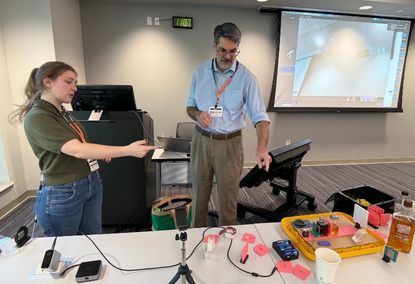
That same curiosity led Olly to participate in a summer research project, exploring whether students without prior experience in quantum physics could independently replicate a quantum computing experiment. The project was connected to research by Dr. Ghislain Lefebvre, Head of the Quantum AlgoLab and Partnerships at the Institut quantique, a quantum research institute in Canada. Working alongside Zaphney Wooldridge ’27 and recent graduate Truitt Baker ’26, Olly pursued two central questions: Could students successfully replicate a complex quantum experiment with limited prior knowledge, and could they navigate the process independently with artificial intelligence (AI) as a learning resource rather than direct teacher guidance? Dr. Lefebvre’s work in quantum computing provided the foundation for the students' experiment.
The project was introduced by Dr. Charles Lena, Upper School Computer Science Teacher and Data Science: Data, Systems, and Society Network Coordinator. As part of ESDistinction — ESD’s curriculum network model for creating interdisciplinary connections across departments, grade levels, programs, and experiences — the Data Science: Data, Systems, and Society network encourages students to use data, statistics, programming, machine learning, and artificial intelligence to investigate authentic questions and develop meaningful solutions.
For Olly, the opportunity to learn through experimentation was a natural fit. “Some of the concepts, I believe, were easier to understand because it was physically happening while I was learning,” she explained. “Quantum is such an interesting realm, so being able to learn by doing was extremely helpful.”
The research process required plenty of problem-solving. After reviewing Dr. Lefebvre’s paper and receiving an initial demonstration of polarization from Dr. Lena, the students took the lead on the experiment, navigating unfamiliar materials, calibrating equipment, and troubleshooting unexpected challenges. They even improvised with materials they could not obtain in time, using salt shakers to hold their maple syrup and agave syrup solutions. Throughout the process, they also used AI to help explain unfamiliar concepts and work through technical difficulties.
Although the group was ultimately unable to complete the portion of the experiment involving a calcite crystal, they successfully completed the other components. More importantly, the experience gave the students an opportunity to apply scientific concepts, evaluate their own approaches, and learn through trial and error. Read more about Olly's summer research project and the students' exploration of quantum computing here.
The summer research culminated in an opportunity to share their work at IEEE Quantum Week in Toronto. During the conference, Olly presented her research to attendees from around the world, including representatives from IBM and NVIDIA, as well as the United Nations advisor on quantum technology and AI, Sanskriti Deva. She also connected with other high school students presenting their own research and attended a session focused on bringing quantum education into K-12 schools, where she made connections with university researchers in Canada.
One of the most meaningful moments came when Olly had the opportunity to present her paper directly to Dr. Lefebvre. Initially nervous about his reaction, Olly quickly found herself encouraged by the enthusiasm of conference attendees. When Dr. Lefebvre eventually visited her poster, his response exceeded her expectations.
“He couldn’t stop smiling, and I could tell he was elated that someone had done his experiment and had such a positive takeaway that they were presenting it at a conference,” Olly recalled. Dr. Lefebvre asked questions about her experience, demonstrated the calcite crystal experiment for her, and later reached out through LinkedIn to thank her for sharing the research and compliment the paper.
Another memorable connection came through Fiona Thompson, a scientist from the University of Waterloo who works to bring quantum education into K-12 schools. After meeting during the conference's K-12 session, the two connected over their shared interests and experiences as women in science, technology, engineering, and mathematics (STEM). Following Olly’s poster presentation, Thompson encouraged her to continue pursuing her interests, even if her path looked unconventional. As Olly and her sister prepared to leave, Thompson jokingly asked if she could adopt Olly and bring her back to Waterloo. The exchange was lighthearted, but its impact was meaningful.
“The joke gave me a sense of belonging; I felt like it was a sign that I am on the right track,” Olly said.
Olly credits much of her journey to the encouragement she has received throughout her time at ESD. Having attended the school since Beginner and continued through Middle and Upper School, she points to teachers who recognized and supported her curiosity at every stage. Seventh grade science helped spark her interest in understanding how things work, while eighth grade science with Scott Goetsch, Middle School Science Teacher and current Eighth Grade Dean, gave her the opportunity to explore black holes through a space research project. Her eighth-grade advisor, Jason Harkey, Middle School Math Teacher, has also remained an important source of encouragement.
In Upper School, Olly's interest in physics has continued to grow. She successfully advocated for the opportunity to take AP Physics 1 as a sophomore, where she found a particularly encouraging mentor in Kayla Fauber, Upper School Science Teacher. She also credits Dr. Lena with providing consistent mentorship and support, describing his dedication to helping students succeed as something she deeply admires.
For Olly, the experience in Toronto reinforced something she has come to recognize about herself: curiosity is one of her greatest strengths.
“Looking back, I am most proud of my curiosity,” she said. “I didn’t have any other reason to do the experiment other than out of curiosity.”
That curiosity, supported by years of encouragement and opportunities to explore beyond the classroom, took Olly from a seventh grader fascinated by black holes to an Upper School student presenting quantum computing research on an international stage. Her advice to other students considering research or an opportunity that feels intimidating? “As scary as presenting sounds, it is really just showing off curiosity and excitement.”