
Beyond the Atmosphere: A Morning with NASA's Dr. Dave Woffinden
April 1, 2026
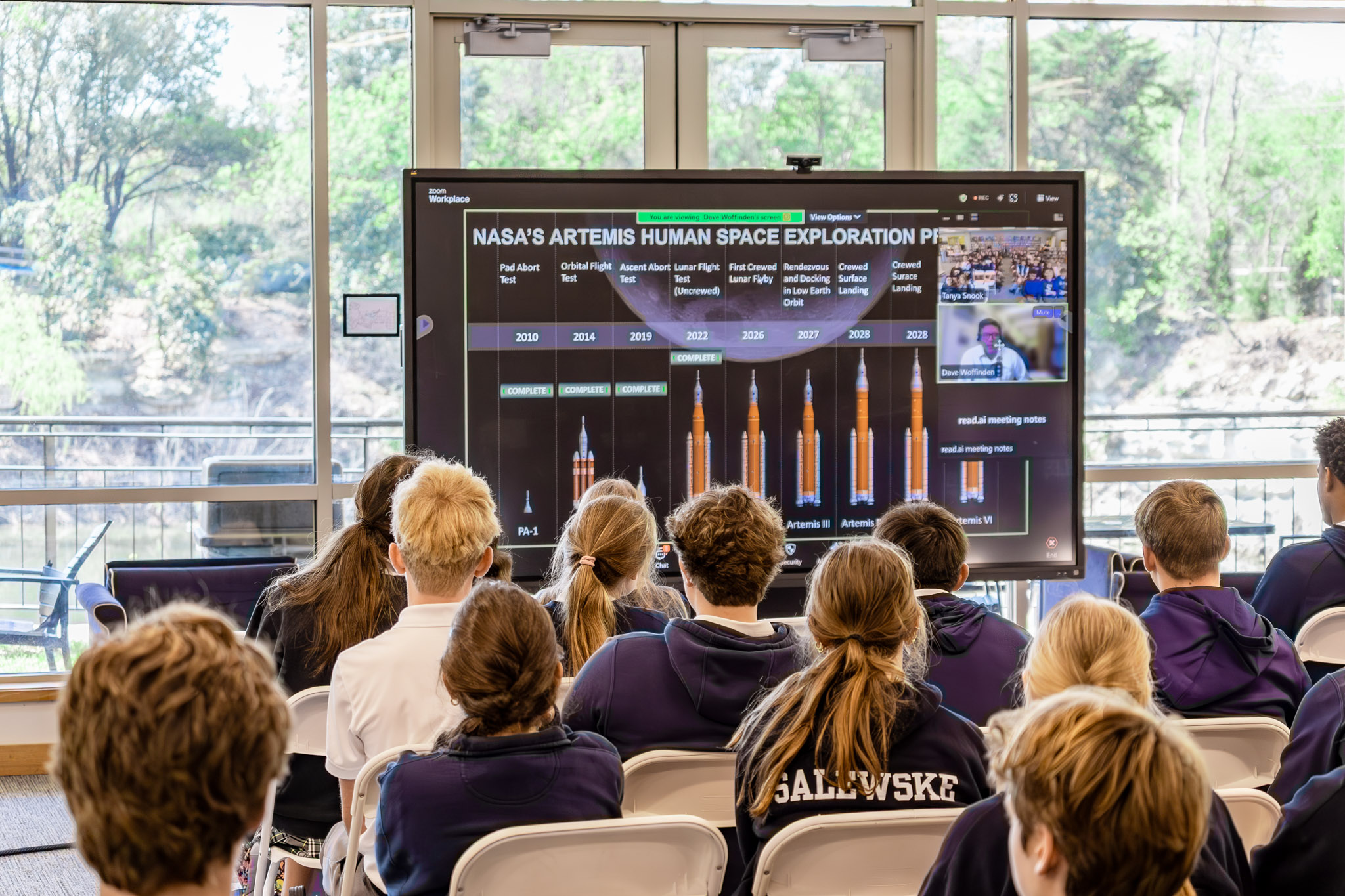
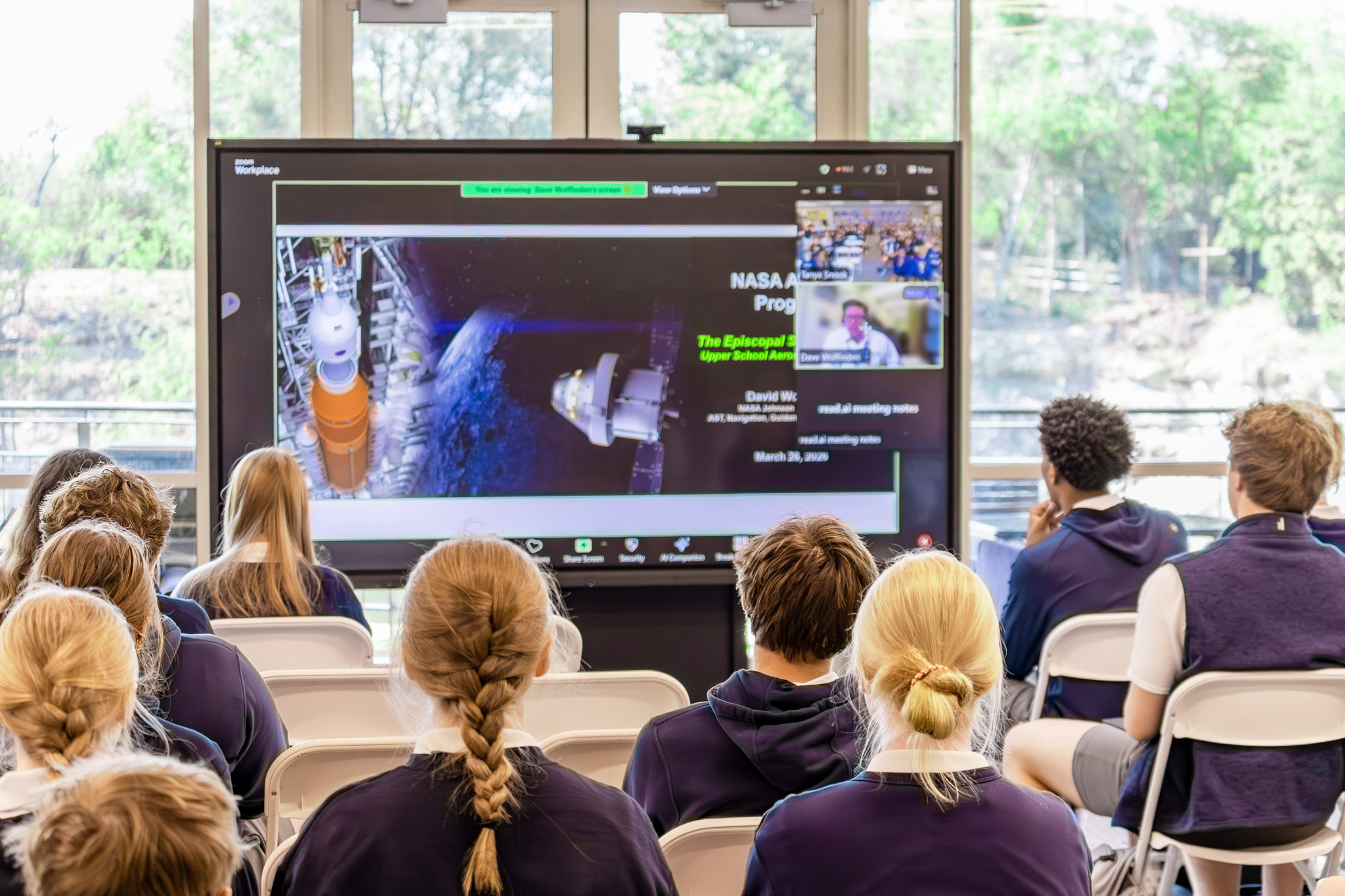
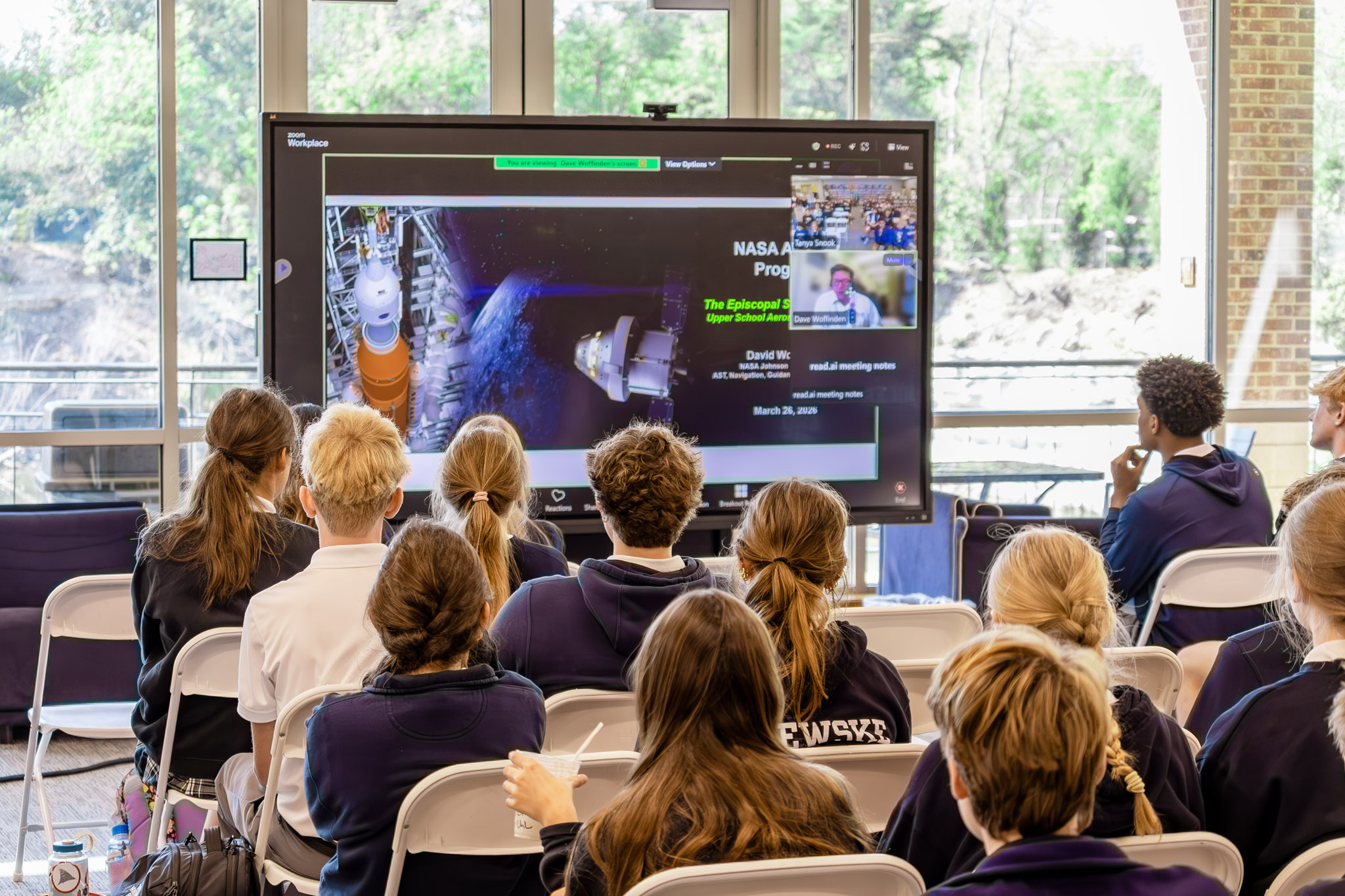
The air in the Gill Library was full of anticipation and energy last week. While the rest of campus buzzed with the usual rhythm of the school day, our Upper School Aerospace Engineering, Mechanical Engineering, and Principles of Engineering and Programming (PEP) students, as well as some of our eighth-grade engineering students, were worlds away: specifically, 238,855 miles away.
We were honored to host Dr. Dave Woffinden from NASA’s Johnson Space Center for an intimate look at the Artemis II program. With the mission’s lunar flyby scheduled for the near future, the timing couldn’t have been more apropos. Dr. Woffinden didn’t just bring data; he brought the sheer scale of human ambition into our classroom.
The session was a masterclass in high-stakes engineering. Dr. Woffinden pulled back the curtain on the Orion spacecraft, detailing the intricate “dance” of orbital mechanics required to break Earth’s orbit. Our students leaned in as he explained:
- The Trajectory: The precise physics of the translunar injection burn that will catapult four astronauts toward the lunar vicinity.
- Deep Space Navigation: How teams navigate when GPS is no longer an option, relying instead on the Deep Space Network and optical navigation.
- Systems Integration: The delicate balance of thermal and power constraints that make Orion a significantly more complex vessel to pilot than its Apollo-era predecessors.
In a fascinating turn, Dr. Woffinden shared how the most “human” elements, such as a crew member exercising or even using the restroom, create physical disturbances that must be accounted for in the spacecraft’s course. It was a vivid reminder that in space, every action has a mathematical reaction.
The technical lecture soon shifted into a spirited Q&A. Our students, ever curious, pushed beyond the hardware to ask about the lived experience of the astronauts. The conversation touched on:
- Circadian Rhythms: How crews manage 8–10 hours of “quiet time” while their bodies adjust to the weightless environment.
- The Apollo Legacy: Understanding how Artemis builds upon the foundations of the 1960s while tackling the modern challenges of long-duration missions.
- Daily Life: From the logistics of space-bound meals to the rigorous quarantine procedures that protect the crew before they ever step onto the launchpad.
Perhaps the most impactful moment of the morning was when Dr. Woffinden shared his own journey. From his days in high school to his time at MIT and eventually NASA, he mapped out a clear path for the aspiring engineers sitting in our gallery. He highlighted the NASA Pathways internship program and the “critical hires” process, offering a roadmap for our students to turn their current projects into future careers.
“Managing the complexity of multiple interconnected systems is our biggest challenge,” Dr. Woffinden noted. “But it’s also where the most exciting work happens.”
As the session ended, the students didn’t just leave with notes on escape velocity; they left with the realization that the people who send humans to the moon were once sitting exactly where they are today. At The Episcopal School of Dallas, we don’t just study history—we prepare our students to write the next chapter of it.